
 EN
EN 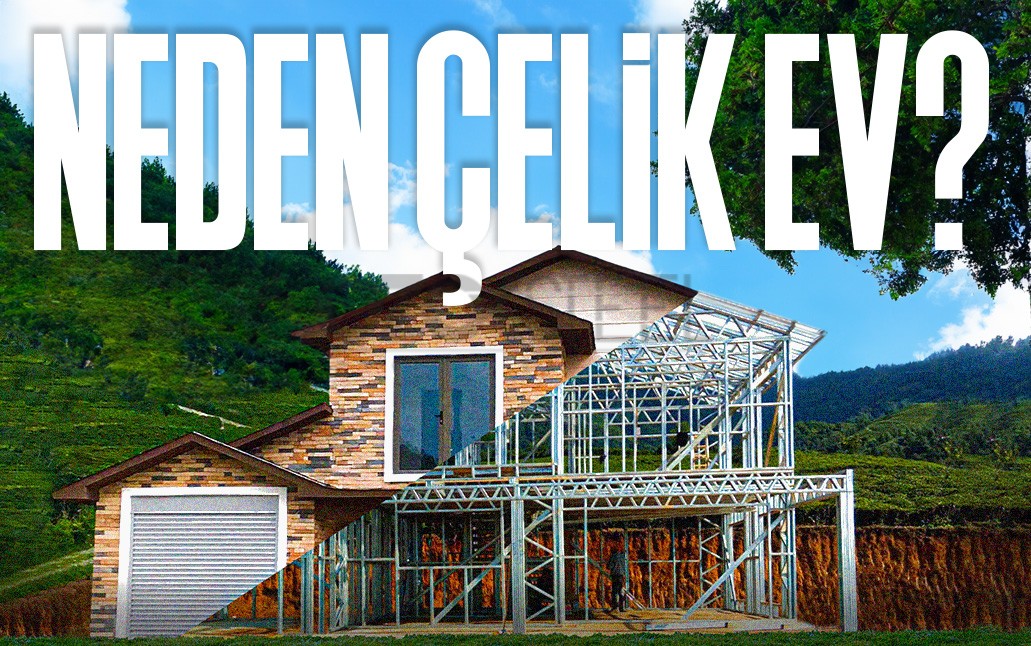
The answer to why choose a steel house is not one single advantage but a combination of practical benefits: a lighter structure, factory-based production, a shorter site programme, and a structural system that behaves favourably under earthquake loads. In this article we look at the reasons for choosing a steel house without exaggeration — and cover something just as important: the situations where a steel house may not be the right choice.
Why Choose a Steel House?
Steel is a material used across many sectors, from automotive to electronics, with properties defined by standards. What has driven its adoption in construction is its measurability: the strength of a factory-produced steel profile is known, certified, and does not change on site.
This predictability means the calculation stays close to reality. The gap between the values an engineer uses to calculate a steel structural system and the values of the material that actually arrives on site is narrow. With cast-in-place concrete, by contrast, the result can vary from batch to batch depending on the mix ratio, curing conditions, air temperature, and workmanship.
Why Is a Steel House Preferred?
It is a well-known fact that construction projects tend to take a long time. Projects that stretch out over time mean a long wait. Because steel houses are prefabricated, the construction phase is shortened; this makes a steel house attractive for many projects compared with the reinforced concrete alternative.
The reason for the shorter timeline is simple: the structural members and panels can be manufactured in the factory while you go through the permit process in Turkey. Time spent on site is limited to assembly and finishing work. However, one point needs to be stated clearly — what usually determines the total timeline is not production, but the building permit and ground survey process. These two items work the same way regardless of the structural system. We cover the steps of this process in our construction stages article.
What Is the Structure of a Steel House?
In a steel structural system, concrete is used only for the foundation and the plinth. Because structural members can be produced with small cross-sections, wall thicknesses stay thinner than with conventional walls; for a building of the same external dimensions, this means more usable interior space. How much space is gained depends on the floor plan and the section chosen.
Two properties are decisive when it comes to earthquakes. The first is lightness: because earthquake force increases in proportion to the mass of the structure, the force acting on a lighter structure is also lower. The second is ductility: steel absorbs energy by deforming rather than breaking. Combined, these two properties mean the structural system behaves favourably under earthquake loads.
It is important not to overstate this. No type of structure can be called "indestructible" or "damage-proof"; lightness and ductility are factors that reduce the risk of damage, not a guarantee. Structural safety is determined less by the material than by the design, the ground conditions, and the quality of execution. We cover this in detail in our earthquake resistance article.

What Are the Advantages of a Steel House?
The reasons for choosing a steel house should be read not as a list of independent advantages but as a chain in which each link supports the next. Because the material's properties are known, the calculation is reliable; because the calculation is reliable, the structural system can be designed without using more material than necessary; because the system is light, the load on the foundation and from earthquakes is reduced. The points below are the links in that chain.
The main advantages a steel house offers are as follows:
- Material properties are defined by standards and, thanks to factory production, do not change on site.
- Its ductile behaviour lets it absorb earthquake energy by deforming.
- The gap between calculation and site conditions is narrow; the behaviour anticipated in the design is largely matched in practice.
- It does not lose strength during transport; there are no freezing or curing issues as there can be with poured concrete.
- In the event of damage, reinforcement and repair are more accessible than with reinforced concrete.
- It is a recyclable material, and the scrap-steel supply chain functions in practice.
- Thanks to bolted and screwed connections, it can be dismantled and re-erected.
- Because production takes place in the factory, manufacturing is largely independent of weather conditions.
- It can be applied under different ground conditions, with a foundation solution matched to the geotechnical survey results.
The Features That Make a Difference in a Steel House
The points that stand out compared with reinforced concrete:
| Feature | What it means in practice |
|---|---|
| High load capacity relative to weight | The same strength is achieved with less material |
| Low structural weight | Load on the foundation and earthquake force are reduced |
| Galvanized coating | Provides protection against corrosion |
| Dry-system construction | Less water, mud, and waste generated on site |
Steel also does not produce problems such as cracking, insect damage, or moisture-related warping.
When Do These Advantages Actually Apply?
Looking at the list above and concluding that "every steel house is therefore good" would be wrong. None of these advantages happen automatically; each one depends on a specific condition.
- The benefit of lightness appears only when the foundation is designed correctly. If the geotechnical survey is skipped or the foundation is inadequately configured, the lightness of the superstructure will not save the result.
- The benefit of ductility appears only when the connections are made correctly. In a steel structure, structural behaviour is determined as much by the connection details as by the profiles themselves.
- The speed advantage appears only when the permit process runs in parallel. However fast production is, the site waits if the permit process in Turkey has not started.
- Energy efficiency appears only when the insulation build-up is configured correctly. Steel is a metal that conducts heat; comfort is provided not by the frame itself but by the layers around it and by breaking the thermal bridges.
These four points turn the choice of a steel house into a decision about workmanship quality rather than a decision about material. When getting quotes, asking which details a company works with is more revealing than asking about the material's brand.
Three Questions to Ask When Getting a Quote
The questions that make a comparison meaningful are these: Who is preparing the structural design, and do they have experience with light steel systems? Does the scope of the quote include the foundation, the building permit, and the utility connections? What layers make up the insulation build-up, and how are the thermal bridges broken? The answers to these three questions usually explain the real reason for the difference between two quotes.
When Is a Steel House Not the Right Choice?
An honest article on why to choose a steel house should not skip this heading. A steel house is not the best answer for every scenario:
- In multi-storey and large-scale buildings, light steel alone may not be sufficient; the structural system may require a hybrid configuration.
- If mass-based acoustic insulation is a priority, reinforced concrete has a natural advantage. In steel, this performance is achieved through the layer build-up and requires correct execution.
- If there is no experienced contractor in the region, the system's advantage can be lost in the workmanship. In a steel structure, the quality of the details and the assembly directly determines the result.
- If buyer familiarity matters, reinforced concrete is still the better-known product on the resale market.
You can take a look at our reinforced concrete or steel house article, where we cover this comparison as a whole.

In Which Areas Are Steel Constructions Preferred?
A steel structural system is not limited to housing. Common areas of application:
- Houses and villas
- Prefabricated steel structures
- Sports facilities
- Hangars and warehouses
- Factory buildings and workshops
- Office buildings
Steel construction buildings, widely preferred in countries such as the United States, Canada, Japan, and the United Kingdom, have long been used in regions with earthquake risk. The prevalence of the system in these countries is not, on its own, a sign of quality; but it does reflect accumulated experience of how this type of building stock behaves over the long term.
At Özok Steel, we work with flexible design and a structural configuration that accounts for earthquake loads; on every project, we finalise the structural calculation and the insulation build-up according to the conditions of the plot.
Frequently Asked Questions
Is a steel house safer than reinforced concrete?
Both are safe when designed in compliance with the relevant code and built correctly. The advantage of light steel is its low structural weight and ductile behaviour, which reduce earthquake force and the risk of damage. However, no system can be guaranteed indestructible — safety is determined by the ground conditions, the design, and the quality of execution.
Is a steel house cheaper than reinforced concrete?
There is no clear-cut advantage either way; the result depends on the project. Using less concrete in the foundation and a shorter site programme work in its favour, but cladding, insulation, and interior fit-out choices determine the total cost. A meaningful comparison can only be made between two quotes of the same scope.
How long does it take to complete a steel house?
The production and assembly stage is shorter than with conventional construction, but the total timeline is determined by the building permit process in Turkey, the geotechnical survey, and the foundation works. These proceed in a similar way regardless of the structural system. A clear schedule can only be produced once the plot and project details are known.
Does a steel house require maintenance?
The structural system is protected by its galvanized coating and does not require routine maintenance. Maintenance needs mainly arise in the building envelope: roof and facade details, joints, and waterproofing should be checked regularly. This is a requirement that applies to every type of building.
Can a steel house get a mortgage and an occupancy permit?
A steel house built with a building permit and granted an occupancy permit has the same status as any other building in Turkey; once a residential record is entered on the title deed, a mortgage application can be made. What matters is not the type of structural system, but whether the building permit and occupancy permit process has been completed.
This article is for general information purposes. Structural safety and cost vary depending on the ground conditions of the plot, the zoning status, and the quality of execution; for an assessment specific to your project, we recommend consulting your design engineer and the municipality you fall under in Turkey.
