
 EN
EN 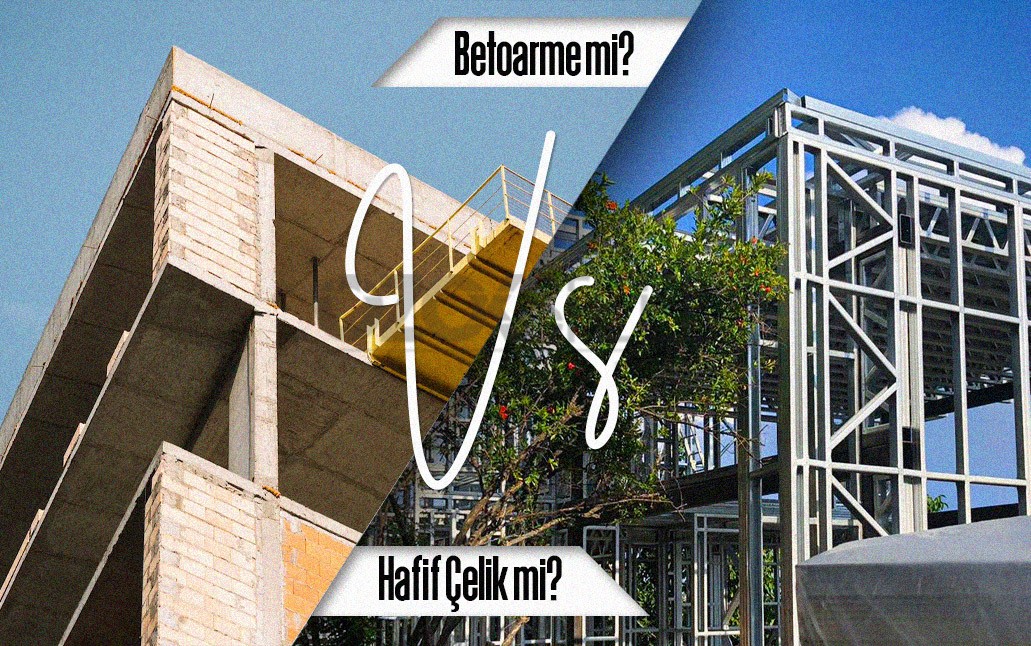
Reinforced concrete or steel house has no single right answer: at multi-storey and apartment-building scale, reinforced concrete is the standard, proven solution, while for low-rise detached housing, light steel stands out for its lightness, short construction time and the predictable quality of factory production. Both systems are safe when designed to the regulations and correctly built. In this guide, we address the reinforced concrete vs. steel comparison by honestly acknowledging the real advantages on both sides.
Reinforced Concrete or Steel House?
This question is drawing more attention every day from anyone hoping to become a homeowner. If we are to answer the reinforced concrete or steel house question, both building types have their own advantages. Depending on their different goals and preferences, people can choose whichever of the two building types suits them.
Reinforced Concrete or Steel House? Which Is More Advantageous?
Between houses built with the steel building system and reinforced concrete buildings, there are areas where both building types have the advantage. If we compare steel houses with reinforced concrete houses:
- Reinforced concrete can be built to a very large number of storeys; the number of storeys achievable with light steel is limited. This is why reinforced concrete is the standard solution at apartment and high-rise building scale
- Because steel construction buildings are lighter, the load imposed on the building during an earthquake is lower; combined with correct design, this is a favourable characteristic for earthquake behaviour
- Both building types can be built for multiple purposes; thanks to its storey-count advantage, reinforced concrete can be used across a wider range of building types
- In reinforced concrete, quality depends largely on the site's pouring and workmanship conditions; in light steel, because the structural profiles are factory-made, material quality is more predictable. A well-supervised reinforced concrete site can, of course, reach the same level of safety
- The construction time for steel houses is much shorter than for reinforced concrete
- The answer to "is steel or reinforced concrete cheaper?" depends on the project; steel saves on time, labour and foundation load, while on the reinforced concrete side, the availability of materials and skilled tradespeople increases price competition
- Light steel construction houses are environmentally friendly thanks to their high recycling rate
- Steel is not a combustible material; correct detailing and earthing provide fire and lightning safety. Reinforced concrete is also a system with high fire resistance
How Do the Two Systems Work: The Fundamental Difference
Reinforced concrete is a cast-in-place system formed by placing reinforcing steel inside formwork erected on site and pouring concrete. Its structural strength comes from the concrete and the reinforcement working together; after pouring, the concrete gains its strength by completing the curing process. The performance of the system therefore depends directly on site conditions, concrete quality and workmanship.
In a light steel house, by contrast, the structural frame is produced by cutting and preparing galvanized steel profiles in the factory according to the project; it is then assembled on site panel by panel with screwed connections. The wall build-up — structural profile, insulation layers and cladding — is designed as a whole from the outset. A light steel house also sits on a reinforced concrete foundation; the difference lies in how the superstructure is produced.
In short, the difference is not just the material but the production logic: reinforced concrete casts the building on site, while light steel manufactures the building in the factory and assembles it on site. Most of the differences in time, quality control and the site process stem from this distinction.
Steel vs. Reinforced Concrete House: Strengths on Both Sides
Light steel houses offer their users many important advantages. The advantages of light steel structures are:
- They are environmentally friendly buildings made from highly recyclable material
- They perform well in energy efficiency and in sustaining that efficiency
- Because steel is light, buildings can be constructed even in difficult site conditions
- Its lightness and ductility, combined with correct design, provide favourable behaviour against earthquake loads
- Thanks to the panel structural system, no columns protrude into the interior, giving a tidier appearance and saving space
- Houses that receive regular maintenance are long-lasting
- They are built quite quickly
- They save on shell-and-core construction time and labour costs
- They offer great convenience for installation and insulation work
- Because the structural system is prepared in the factory, production is not affected by climate or weather conditions
The Strengths of Reinforced Concrete
An honest reinforced concrete vs. steel comparison can only be made by also acknowledging the other side's advantages. The genuine strengths of reinforced concrete are:
- It has been the proven standard solution for high-rise and large-scale buildings for decades
- It has high mass; this mass forms a natural buffer against sound transmission and indoor temperature fluctuations
- Its tradespeople, foremen, contractors and materials are available in almost every locality; its ecosystem is very widespread
- Maintenance and renovation practices have been known for many years; there is a broad accumulation of experience in how to solve which problem
- As the most familiar building type in valuation and appraisal processes, buying and selling practices are well established for it
Comparison Table: Reinforced Concrete and Light Steel
In the table below, we have placed the two systems side by side on the key criteria. We have deliberately kept the wording qualitative; duration, lifespan and cost can vary significantly even within the same system, depending on the project, the ground and the quality of workmanship.
| Criterion | Reinforced Concrete | Light Steel |
|---|---|---|
| Building weight | Heavy; earthquake load increases with mass | Light; low load on the structural system |
| Construction time | Longer; curing periods dictate the schedule | Shorter; factory production and dry assembly |
| Number of storeys | Wide range, including high-rise buildings | Ideal at low-rise housing scale |
| Quality control | Cast on site; dependent on supervision | Factory production; more predictable |
| Sound and thermal mass | High; a natural advantage from its mass | Achieved in the design through layered insulation |
| Availability of tradespeople and firms | Very widespread | Requires a specialist manufacturing firm |
| Maintenance | Well-known practices; requires monitoring reinforcement corrosion | Galvanized protection; cladding and detail maintenance |
The Difference in Earthquake Behaviour
The load acting on a building during an earthquake is directly proportional to the building's mass: the lighter the building, the lower the load the shaking imposes on the structural system. Because light steel buildings are markedly lighter than reinforced concrete, and because steel is a ductile material that can deform without fracturing, correctly designed light steel buildings show favourable behaviour under earthquake loads. We cover this topic in detail in our article on how steel houses behave in earthquakes.
This does not mean that reinforced concrete is unsafe. Reinforced concrete buildings designed to the earthquake regulations in force in Turkey, properly supervised and built with correct workmanship, also provide earthquake safety. No building type can be described as one that "will not collapse" in an earthquake; what really determines the outcome is not the name of the structural system, but the quality of the geotechnical survey, design, supervision and workmanship. The right question is not "which is stronger" but "which system will be correctly implemented under the right conditions for my project".
The Difference in Construction Time and Site Process
A reinforced concrete site proceeds on a wet-construction basis: formwork is erected, reinforcement is tied, concrete is poured and the curing period is waited out; storeys rise through repetition of this cycle. Concrete pouring is sensitive to weather conditions; extra measures are needed in extreme heat and cold, and the schedule can be extended depending on the season.
In light steel, the structural system is manufactured in the factory while foundation preparation proceeds on site; the two workstreams run in parallel. Because the site side is mainly dry assembly, there is no curing wait and the process is far less affected by weather conditions. This is why the construction time of steel houses is shorter than that of reinforced concrete.
It has to be said honestly: the foundation of a light steel house is also reinforced concrete, and the design and building-permit process in Turkey follows the same official steps for both systems. The time saved is in the shell-and-core and assembly stage; the overall schedule is determined by site conditions, the permit process and interior finishing work.
Which Is More Sensible for Which Situation?
The most honest summary of the comparison is not the question "which is better" but "which one for which job":
- If you are building a multi-storey building or an apartment block: Reinforced concrete is the standard, proven solution at this scale; light steel, being a housing-scale system, does not come into play in this scenario.
- If you are planning a low-rise detached house, villa or country house: Light steel is a strong candidate; its lightness, fast assembly and factory production come fully into their own at this scale.
- If your schedule is tight: Steel provides a clear time advantage in the shell-and-core and assembly stage; with no curing wait, the process is less affected by the season.
- If sound and a sense of mass are a priority for you: Reinforced concrete has a natural advantage from its mass; in steel, the same comfort requires insulation layers to be planned and budgeted for from the outset.
- If there is no experienced steel manufacturer in your region: Reinforced concrete's tradesperson and contractor ecosystem exists almost everywhere; in light steel, working with the right manufacturer who takes on the whole job is essential.
As you can see, there are scenarios where each system wins. What matters is making the decision based on the realities of your site, your budget and your intended use, not on sales pitches.
Where Does Prefabricated Fit into This Comparison?
Prefabricated houses are also buildings seeing rising demand, and compared with reinforced concrete, they offer advantages similar to steel houses in lightness and construction time. However, their structural systems differ: in a light steel house, a galvanized steel frame carries the loads, while in prefabricated buildings the wall panels take on the structural role. This is a separate topic from the reinforced concrete comparison covered in this article; you can examine the differences and advantages of the two systems in detail in our prefabricated house and steel house differences article.
Frequently Asked Questions
Is a steel house safer than reinforced concrete?
Both systems are safe when designed and supervised in accordance with the earthquake regulations in force in Turkey. Light steel buildings show favourable behaviour under earthquake loads thanks to their lightness and ductility; reinforced concrete meets the same safety goal when correctly built. What matters is not the name of the system but the quality of the geotechnical survey, design, supervision and workmanship.
Is a steel house cheaper than reinforced concrete?
It depends on the project. Light steel can save on items such as shell-and-core construction time, labour and the need for a lighter foundation. On the reinforced concrete side, the availability of materials and skilled tradespeople increases price competition. What really determines total cost is site conditions, floor area, insulation level and interior fit-out quality; a clear comparison can only be made by pricing the same project in both systems.
Does reinforced concrete last longer?
Both systems are long-lasting with regular maintenance. In reinforced concrete, reinforcement corrosion and damage to the concrete surface must be monitored over time; in light steel, the structural profiles are protected against corrosion by galvanized coating. What really determines lifespan is construction quality, insulation detailing and regular maintenance; it would not be correct to claim a definite lifespan advantage based on the name of the system alone.
Do banks offer mortgages for both?
For a mortgage, a bank looks at the legal status of the property in Turkey, not the type of structural system. A home with a building permit, an occupancy permit and a title deed can be considered for a mortgage, whether reinforced concrete or light steel. Since practice varies by bank, we recommend speaking to your chosen bank before starting the process.
Is the acoustic insulation of a steel house as good as reinforced concrete?
Reinforced concrete has a natural advantage against sound transmission thanks to its mass, and this needs to be openly acknowledged. In light steel buildings, the same comfort is achieved with insulation materials added to the wall and floor layers. A correctly designed, layered wall reaches sufficient acoustic insulation for residential comfort; the difference is that this needs to be planned from the outset.
The steel house advantages seen in these sections make steel buildings quite appealing. At Özok Steel, we offer you a high-quality, reliable steel house construction service. To have a home or homes suited to your wishes and goals, you can get in touch with us.
This article is for general information only; the choice of building system depends on site conditions, zoning status and the scale of the project. Before making a final decision, we recommend evaluating your project together with a civil engineer and the municipality your land falls under in Turkey.
